February 26, 2026 | Read Time: 1 Min. | Volunteers

February 26, 2026 | Read Time: 1 Min. | Volunteers
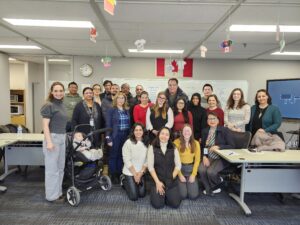
Volunteers gathered to better understand the Canadian legal system.
Each month, our CBFY volunteers gather for a morning of professional development, where we learn about Canadian life and culture, meet other CBFY volunteers, and share our stories. On February 24th, more than 20 volunteers attended the Bridge Circle to learn about Canadian Law and the legal system.
Molly Clare, the Peace and Justice Project Program Coordinator at CBFY, shared her expertise with us as she presented information about Canadian Law and the legal system.
She began the session asking us what we think of when we hear the words Canadian Law. “Strict”, “courts”, “policy” and “procedure” were words that came to our minds.
Molly described the Canadian Legal System to us, touching on the key differences between the Criminal Justice System and the Civil Legal Systems here. The criminal justice system is society punishing a person for wrong doing, while the civil legal system is individual versus individual, or individual versus entity. She emphasized that the Canadian Legal System focuses on restorative justice, and prioritizes rehabilitation and healing, rather than punishment.
Together, we learned the two principles that criminal responsibility and intent hinges on: mens rea (mental intent) and actus reus (physical act). The mental intent is if the accused knew the difference between right and wrong at the time of the crime, and the physical act is if the accused did the physical crime.
Molly also taught us the differences between the adult criminal justice system and the youth criminal justice system in Canada. The criminal justice system for ages 12-17 is very restorative, and employs tools to support the youth, providing opportunities to make the right decisions in the future, she explained.
As a group, Molly walked us through the criminal court processes, from the time someone is accused to the trial. We learned about sentencing options that range from absolute discharge; when there is not enough evidence to prove a crime and the accused has no criminal record after discharge, to incarceration; when the accused is sentenced to jail time.
After learning about the criminal justice system, Molly taught us about the civil legal system, where common cases are divorce, parenting orders, or restraining orders. She informed us of victim rights in the Civil Legal System: right to receive information about the case status, protection against intimidation and harassment, and the right to actively participate in proceedings.
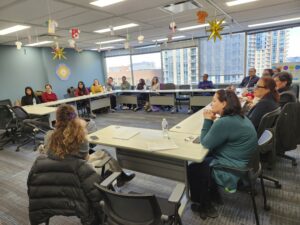
The volunteers were then led through an activity to test our new knowledge. Molly read off scenarios that ranged from stealing a phone to a child custody court case, and we decided if the case would go through the Criminal Justice System or the Civil Legal System. The group got them all correct – a testament to Molly’s excellent teaching!
Molly’s passion and expertise in the subject of the Canadian legal system was apparent throughout the workshop. She ensured that we all had as complete of an understanding of our rights as we could in the two hour session.
At the end of the session, Molly told us the most important thing when dealing with the legal system is to advocate for oneself. She said if someone needs a translator or special assistance, they must ask.
She concluded the session by giving us all a handout with links and phone numbers to various resources in Calgary for legal and court assistance, victim serving agencies, free/low barrier counselling services, and restitution services.
Thank you, Molly for sharing your knowledge on the Canadian Legal System, and thank you, Arnida for setting up this informative and interesting Bridge Circle!