April 2, 2026 | Read Time: 1 Min. | Volunteers

April 2, 2026 | Read Time: 1 Min. | Volunteers
Volunteers learned about the importance of play in teaching students.
What games do you remember playing as a child? Which was your favorite? Did they influence how and what you learned?
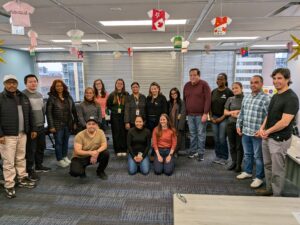
For this Bridge Circle, Tijana Kukoleca gave an interactive presentation to 16 CBFY volunteers, sharing her knowledge on social-emotional learning (SEL) and the importance of play in education.
Many of the volunteers at Bridge Circles are now familiar faces, so we chatted and caught up as we prepared for the presentation.
Tijana began by sharing her story with us: when she came to Calgary as a newcomer from Serbia in 2016, she joined the CBFY Mentorship Program. Then, she volunteered with CBFY for years. In 2021, she was hired as an Afterschool Program facilitator. Now Tijana serves as a Youth Worker for Bridge Club though the Afterschool Program.
Tijana led the group through an icebreaker called Green Glass Door. Everyone introduced themselves and named an item. Tijana let us know if it would open the green glass door, or not. Apple, eggs, and a book opened the door, while papaya, cucumber, and tomato didn’t. Together, we cracked the Green Glass Door code in one guess! I won’t share the code – I don’t want to spoil the game for others!
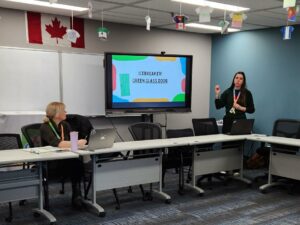
SEL is at the center of all learning, Tijana said. She explained that the social is how we interact with others, while the emotional is how we feel around others.
We then learned the different aspects of SEL: setting and achieving goals, feeling and showing empathy, establishing positive relationships, responsible decision-making, building resiliency, developing knowledge, forming healthy identities, and recognizing and managing emotions. Tijana shared the important role we as volunteers play in supporting students through these aspects. For example, to build resilience, we can help students bounce back from failure by encouraging them to work hard and be kind to themselves.
Tijana shared the 8 types of play: imaginative, constructive, physical, social, sensory, mastery, structured, and communication. While all of these are individual ways to play, they often tie in together and interact. For example, building with Legos combines imagination and construction. A game like charades combines physical play with communication and social play. Different ages respond better to different types of play, but it is essential for all age groups.
“Please do not forget the importance of play for high schoolers,” Tijana said. “Even though they have adult responsibilities, they are still children.”
Tijana then had us partner up to play a game. Each group had one minute to name as many games as we could. The winning team named 15 games!
When teaching students, we must speak the language of youth, and their language is play!
Play is not only a privilege, Tijana said, but a fundamental right for children. It is the building block for learning, development, and well-being, and is essential to navigating challenges, improving mental health, and fostering imagination.
For students attending CBFY programs, play creates a sense of safety and normalcy amid conflict, displacement, and trauma. It can help them cope with fear, anxiety, and the uncertainty of being in a new country. Play acts as the universal language that helps bridge cultural gaps, build social connections, and reduce stress from relocation, Tijana said.
Tijana emphasized that play is not only for children – it can also be very beneficial for adults. The more you play, the more playful your outlook on life can be, Tijana said.
Adults can benefit from scheduling play into their lives, like organizing a hike, a karaoke night with friends, or a time to play recreational sports. She also suggests removing any goals to focus on the experience itself, rather than goals of mastering or winning.
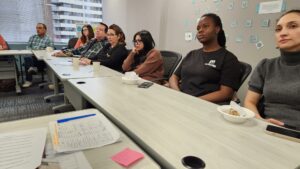
Finally, Tijana recommends some spontaneity: be playful without the worry of appearing silly and give yourself grace.
Before the end of the session, Tijana invited us all to play a game called ‘Splat!’, which is a favorite among CBFY students. The game required quick reaction time: Tijana would point to someone in the circle and yell, “Splat!” They would duck, and the two people on either side would turn to “splat” each other. Whoever reacted slower was out. Though we made mistakes as we played, everyone was able to laugh and be silly. It was a great example of a safe space to try something new, and not take it too seriously!
Thank you, Tijana, for a very informative, fun, and exciting presentation! Thank you to Arnida, our volunteer resource coordinator, for organizing this Bridge Circle, and thank you to Kulwinder, who hosted the event for us on Tuesday!
We will gather on April 21st for our fourth and final Bridge Circle of Season 2.